Basics
In volleyball, the setter acts as the team's "quarterback" or "playmaker," primarily responsible for orchestrating the offense and making split-second decisions. Their main job is to take the second touch of every play and deliver an accurate, well-placed ball to an attacker, putting them in the best position to score a point. To execute this, a setter must master technical fundamentals: they use a staggered stance with the right foot slightly forward to stay balanced and open to the court, and they form a "triangle" with their thumbs and index fingers to contact the ball cleanly with their fingertips above their forehead. Beyond physical technique, the role requires high emotional intelligence and vocal leadership, as setters must communicate offensive plays via hand signals, read the opponent's defense to find weaknesses, and maintain a steady composure to motivate their teammates under pressure.
Rules
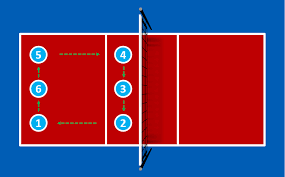
As a setter in volleyball, you are the team’s "quarterback" and primary playmaker, typically responsible for the second contact to orchestrate the attack. Your primary rule is to ensure a clean, simultaneous contact with both hands to avoid a double contact violation, which can be signaled by excessive ball spin, although 2026 rule interpretations increasingly emphasize that "ugly is not illegal" as long as the release is instantaneous. You must also avoid lifts or carries by ensuring the ball does not rest in your palms or stay in contact with your hands too long. Your legal actions depend heavily on your rotation: when in the front row (positions 2, 3, or 4), you can legally block and attack the ball above the net, including performing a "setter dump". However, when you rotate to the back row (positions 1, 6, or 5), you are strictly prohibited from attacking or jumping to hit a ball that is entirely above the height of the net if you are on or in front of the 10-foot (attack) line. Additionally, you must be careful not to overlap with adjacent teammates before the serve is contacted, though you are free to move to your specialized position at the net immediately after the serve is in play.